Thursday, March 22, 2007

And you thought I was joking...

As promised, here is the proof for the Monty Python "Holy Grail" witch scene we saw. I told you it works:

The following example in Predicate Logic is based on the movie “Monty Python and the Holy Grail” (1975). Here is an excerpt of the script for scene #5:

VILLAGER #1: We have found a witch. May we burn her?

CROWD: Burn her! Burn! Burn her! Burn her!

BEDEVERE: How do you know she is a witch?

VILLAGER #2: She looks like one.

CROWD: Right! Yeah! Yeah!

BEDEVERE: Bring her forward.

WITCH: I'm not a witch. I'm not a witch.


BEDEVERE: What makes you think she is a witch?

VILLAGER #3: Well, she turned me into a newt.

BEDEVERE: A newt?

VILLAGER #3: I got better.

VILLAGER #2: Burn her anyway!

VILLAGER #1: Burn!

CROWD: Burn her! Burn! Burn her!...

BEDEVERE: Quiet! Quiet! Quiet! Quiet! There are ways of telling whether she is a witch.

VILLAGER #1: Are there?

VILLAGER #2: Ah?

VILLAGER #1: What are they?

CROWD: Tell us! Tell us!...

BEDEVERE: Tell me. What do you do with witches?

VILLAGER #2: Burn!

VILLAGER #1: Burn!

CROWD: Burn! Burn them up! Burn!...

BEDEVERE: And what do you burn apart from witches?

VILLAGER #1: More witches!

VILLAGER #3: Shh!

VILLAGER #2: Wood!

BEDEVERE: So, why do witches burn?

[pause]

VILLAGER #3: B--... 'cause they're made of... wood?

BEDEVERE: Good! Heh heh.

CROWD: Oh, yeah. Oh.

BEDEVERE: So, how do we tell whether she is made of wood?

VILLAGER #1: Build a bridge out of her.

BEDEVERE: Ah, but can you not also make bridges out of stone?

VILLAGER #1: Oh, yeah.

RANDOM: Oh, yeah. True. Uhh...

BEDEVERE: Does wood sink in water?

VILLAGER #1: No. No.

VILLAGER #2: No, it floats! It floats!

VILLAGER #1: Throw her into the pond!

CROWD: The pond! Throw her into the pond!

BEDEVERE: What also floats in water?


ARTHUR: A duck!

CROWD: Oooh.

BEDEVERE: Exactly. So, logically...

VILLAGER #1: If... she... weighs... the same as a duck,... she's made of wood.

BEDEVERE: And therefore?

VILLAGER #2: A witch!

VILLAGER #1: A witch!

CROWD: A witch! A witch!...

VILLAGER #4: Here is a duck. Use this duck.

[quack quack quack]

BEDEVERE: Very good. We shall use my largest scales.

CROWD: Ohh! Ohh! Burn the witch! Burn the witch! Burn her! Burn her! Burn her! Burn her! Burn her! Burn her! Burn her! Ahh! Ahh...

BEDEVERE: Right. Remove the supports!

[whop]

[clunk]

[creak]

CROWD: A witch! A witch! A witch!

WITCH: It's a fair cop.

VILLAGER #3: Burn her!

CROWD: Burn her! Burn her! Burn her! Burn! Burn!...

BEDEVERE: Who are you who are so wise in the ways of science?

ARTHUR: I am Arthur, King of the Britons.

BEDEVERE: My liege!

ARTHUR: Good Sir Knight, will you come with me to Camelot and join us at the Round Table?

BEDEVERE: My liege! I would be honored.

ARTHUR: What is your name?

BEDEVERE: 'Bedevere', my liege.

ARTHUR: Then I dub you 'Sir Bedevere, Knight of the Round Table'.

Here is the logic:

Rule 1

Rule 2

Rule 3

Fact 1

Fact 2

Fact 3

Fact 4

(Note: Polly is the character name of the actress, who played the witch, in another TV show)

Experiment: ? Result: is true.

Since and , we have. (Rule 3)

Since ,, and , we have . (Rule 2)

Since and , we have . (Rule 1)

So it is actually logically correct.

( Thanks to Prof. Leen-Kiat Soh for the proof - originally for his course "Introduction to Discrete Structures".)

If you guys are interested, check out Gary L. Hardcastle's article, "Themes in Contemporary Analytic Philosophy as Reflected in the Work of Monty Python."

C.

Why Did the Chicken Cross the Road

I just couldn't resist posting this...

C'mon - where else can you get Plato, Nietzsche, Leary, Regan, Mr. T, the Godfather and Jack Nicholson in the same place???

Plato: For the greater good.

Karl Marx: It was a historical inevitability.

Machiavelli: So that its subjects will view it with admiration,
as a chicken which has the daring and courage to
boldly cross the road, but also with fear, for whom
among them has the strength to contend with such a
paragon of avian virtue? In such a manner is the
princely chicken's dominion maintained.

Hippocrates: Because of an excess of light pink gooey stuff in its pancreas.

Jacques Derrida: Any number of contending discourses may be discovered
within the act of the chicken crossing the road, and
each interpretation is equally valid as the authorial
intent can never be discerned, because structuralism
is DEAD, DAMMIT, DEAD!

Timothy Leary: Because that's the only kind of trip the Establishment would let it take.

Douglas Adams: Forty-two.

Nietzsche: Because if you gaze too long across the Road, the Road gazes also across you.

Oliver North: National Security was at stake.

B.F. Skinner: Because the external influences which had pervaded its
sensorium from birth had caused it to develop in such a
fashion that it would tend to cross roads, even while
believing these actions to be of its own free will.

Carl Jung: The confluence of events in the cultural gestalt
necessitated that individual chickens cross roads at
this historical juncture, and therefore
synchronicitously brought such occurrences into being.

Jean-Paul Sartre: In order to act in good faith and be true to itself,
the chicken found it necessary to cross the road.

Albert Einstein: Whether the chicken crossed the road or the road crossed
the chicken depends upon your frame of reference.

Aristotle: To actualize its potential.

Buddha: If you ask this question, you deny your own chicken-nature.

Salvador Dali: The Fish.

Darwin: It was the logical next step after coming down from the trees.

Emily Dickinson: Because it could not stop for death.

Epicurus: For fun.

R. W. Emerson: It didn't cross the road; it transcended it.

Ernest Hemingway: To die. In the rain.

Werner Heisenberg: We are not sure which side of the road the chicken was on, but it was
moving very fast.

David Hume: Out of custom and habit.

Jack Nicholson: 'Cause it (censored) wanted to. That's the (censored)
reason.

Pyrrho the Skeptic: What road?

Ronald Reagan: I forget.

The Sphinx: You tell me.

Mr. T: If you saw me coming you'd cross the road too!

Mark Twain: The news of its crossing has been greatly exaggerated.

Molly Yard: It was a hen!

Zeno of Elea: To prove it could never reach the other side.

Chaucer: So priketh hem nature in hir corages.

Wordsworth: To wander lonely as a cloud.

The Godfather: I didn't want its mother to see it like that.

Keats: Philosophy will clip a chicken's wings.

Blake: To see heaven in a wild fowl.

Othello: Jealousy.

Oscar Wilde: Why, indeed? One's social engagements whilst in
town ought never expose one to such barbarous
inconvenience - although, perhaps, if one must cross a
road, one may do far worse than to cross it as the
chicken in question.

Kafka: Hardly the most urgent enquiry to make of a low-grade
insurance clerk who woke up that morning as a hen.

Swift: It is, of course, inevitable that such a loathsome,
filth-ridden and degraded creature as Man should assume
to question the actions of one in all respects his
superior.

Macbeth: To have turned back were as tedious as to go o'er.

Whitehead: Clearly, having fallen victim to the fallacy of
misplaced concreteness.

Freud: An die andere Seite zu kommen. (Much laughter)

Hamlet: That is not the question.

Donne: It crosseth for thee.

Pope: It was mimicking my Lord Hervey.

Constable: To get a better view.

Intro to Ayer - Links and Such


Well, we're done with Freud and on to...

AYER!!!

As usual, some links to introduce you to this scintillating savant of scholarly scenarios:

First, a longish but very informative and *unbiased* article called A.J. Ayer's Philosophy and its Greatness. If that doesn't interest you, but logic does, then perhaps you'd like to drop by the "Fallacy Files." (I admit it's not quite as much fun as the X-Files, but it's informative, and hey - I'm doing my best...) If you're interested in the category error Ayer talks about, check out this passage from Alice and Wonderland - it does a great job elucidating the problem. And as always, if you're looking for more info go to the Stanford Encyclopedia of Philosophy.

Okay, now for some F-U-N: first, we have a little thing called "stickman logic". It's actually a logic-as-modern-art thing, pretty funny stuff. If that's not for you, I have something even more exciting: learn logic with Beavis and Butthead!! Who knew logic could be so much fun!

For anyone who didn't believe me that with predicate logic you can prove...well, just about anything...here is a link that shows you that the whole world is a goat. (Just think about how you can impress your friends and parents when they ask you what you learned this year at university!)

Briefly, here is the proof for the Goat Thesis:

Goatism Proved by Logic!

Introduction to Propositional Logic

In Propositional Logic every statement is either true or false. There is no third way. For example, the proposition "It is raining outside" is either true or not true. Furthermore, if a statement is false then it's opposite is true. So, if "It is raining outside" is a false statement, then it's opposite "It is not raining outside" must be true.

The Logical Proof

  1. The proposition "Everything is a Goat" is either true or not true.
  2. If it is false, then it's opposite must be true.
  3. The opposite of "everything" is "nothing", which give us the proposition "Nothing is a Goat".*
  4. Now, this statement is clearly false, for goats certainly exist - we have all seen them. This means that it's opposite must be true.
  5. Therefore, "Everything is a Goat" must be a true statement.
Now, those of you who are down with fuzzy logic know this isn't necessarily "true" but it is "correct". So there.

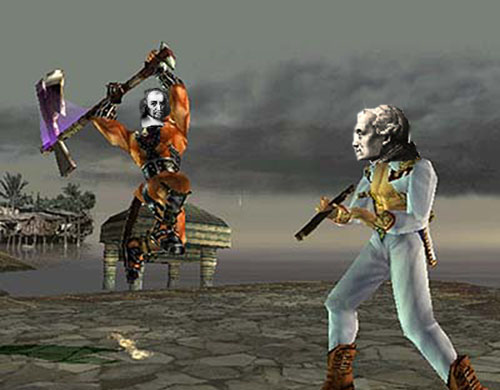
Okay, now just a few things that might be of interest: This is a site for the awesome new game PHILOSOFIGHTER (a sample image - of Hobbes fighting Kant - is above). This is a fun site called "Philosophy of the Beatles" - smart/funny whether you like the fabulous foursome or not.

Alrighty, have fun and I'll see you Monday.

Clara

Friday, March 2, 2007

Intro to Freud - Links and Such

Alrighty ya'll...

Let the Discontentment begin!

Here is a set of discussion questions - think about any or all of them, and come up with something brilliant to share with us on Monday. Remember to leave a comment or two when you feel moved to do so - I'll be keeping track of them to use for discussion.

And, as usual, here are a few links for those of you who like that kind of thing:

First, some lecture notes on Civilization and its Discontents. You can check out this nifty introduction, this super outline,or for clarification of the most important terms and an overview of the book's structure, click here. If you want something a bit more specialized, check out this lecture - it talks about Civilization and its Discontents in relation to Plato, Nietzsche, and Homer (among others).

Second, if you want to expand on some of the themes in the book, there's an interesting PBS site focusing on the debate between science and religion that you can access here.

Third, if you don't like reading (or are just plain sick of it - and who can blame you?) then why not sit back and enjoy one of these brilliant BBC lectures on the Sig-Man himself. This is seriously "quality" programming - the 5th one, about Freud's theory of jokes, is my favourite.

Well, it's a start. More good stuff to come. In the meantime, DO YOUR READING and ride that wave of oceanic feeling.

See you Monday,
Clara

Question #1: Smarter than a Fifth Grader?

Remember this little zinger:

“The whole thing is so patently infantile, so foreign
to reality, that to anyone with a friendly attitude to humanity it
is painful to think that the great majority of mortals will never
be able to rise above this view of life.”

So why does Freud regard the spiritual worldview as
childish? Do you agree?

Question #2: It wasn't me, it was my id! I swear!

Why does Freud play up the role of instincts and play down the role of society or group dynamics. Which do you find more important?

Question #3: Accentuate the...Negative.

What does Freud believe are the negative factors of civilization? Do you agree? If not, what do you think are the most negative factors?

Question #4: It Can Only Go Down From Here?

Do you think that Freud's critique of civilization stands today? Do you think he would find that it's gotten worse or better? What do you think? (Hint: think about the amount of sex and violence on TV.)

Question #5: Civilization and its (Dis) Contents?

What's so terrible about civilization anyway? Are there any positive factors that Freud neglects to talk about?

Question #6: Either/Or...(Not?)

Do you agree with Freud that "scientific" and "religious" worldviews are mutually exclusive? Is it possible to hold both views?

Question #7: What's in a God?

How would you define Freud's idea of religion? Do you believe that this is an exhaustive account of what religion is?